How to Make Your Food Business Legal in Malaysia
Selling food in Malaysia without the right approvals is illegal, even from home or online. To operate legally, a food business must be registered, licensed, and run by trained food handlers under the Food Act 1983 and its regulations. This guide walks through every step to make your food business legal in Malaysia, from SSM registration to local council licences, food handler requirements, and when you need MeSTI, MS 1514 GMP or MS 1480 HACCP certification.
What Makes a Food Business Legal in Malaysia?
A food business is legal in Malaysia when it is registered with the Companies Commission of Malaysia (SSM), licensed by the local authority, registered in the Food Safety Information System of Malaysia (FoSIM), and operated by food handlers who are trained and vaccinated. These requirements sit under the Food Act 1983, the Food Regulations 1985, and the Food Hygiene Regulations 2009, all enforced by the Ministry of Health (MOH).
No single licence makes a food business legal on its own. Legality is a stack of approvals: a registered business entity, a valid premises licence from your local council, MOH food premises registration, and compliant food handlers. Miss any layer and the business is operating unlawfully, regardless of how good the food is. The exact combination depends on your business type. A home baker, a restaurant, and a packaged-food manufacturer each face a different subset of these requirements, which the sections below break down.
How Do You Register a Food Business with SSM?
You register a food business with SSM through its ezBiz online portal, choosing a sole proprietorship, partnership, or private limited company (Sdn Bhd). SSM registration gives the business a legal identity and is the prerequisite for every other licence and approval. No local council will issue a premises licence without it.
Sole proprietorships and partnerships are the fastest route for small operators and are registered under the Registration of Businesses Act 1956. A private limited company, registered under the Companies Act 2016, is the better structure once you take on staff, seek external funding, or supply larger buyers who require a company to deal with. Registration must be renewed on schedule, and the business name and activity must accurately reflect food-related operations. In our experience, using a generic or mismatched business activity code is a common early mistake that causes friction later when applying for food premises licences or MeSTI certification.

What Licences Do You Need from the Local Council?
Every food premises in Malaysia needs a business premises licence and a signboard licence from the local authority (PBT), such as DBKL in Kuala Lumpur or the relevant Majlis Perbandaran or Majlis Bandaraya. These licences authorise you to operate at a specific location and to display your business sign. The local authority inspects the premises before approval.
Approval depends on the premises meeting basic health, hygiene, and safety standards. Councils typically check the layout of food preparation areas, waste disposal, pest control, ventilation, and access to hand-washing facilities. Some councils also require fire safety (Bomba) clearance for certain premises. Requirements and processing times vary between local authorities, so the safest approach is to confirm the checklist with your specific PBT before signing a tenancy or fitting out a kitchen. Home-based food businesses are not exempt. Most councils require a home business licence, and selling home-cooked food commercially without one is an offence.
What Are the Food Handler and Hygiene Requirements?
Every person who handles food commercially in Malaysia must complete a MOH-recognised food handler training course and receive a typhoid vaccination. The food handler certificate is valid for life following a 2024 change, but the typhoid vaccination must be renewed every three years. Both are checked during MOH and local authority inspections.
Alongside these individual requirements, the premises itself must be registered in FoSIM, the Ministry of Health’s Food Safety Information System, which the MOH uses to track and inspect food premises nationwide. The Food Hygiene Regulations 2009 set the operating standards for cleanliness, food storage, temperature control, and cross-contamination prevention that inspectors enforce. In our work with food businesses, FoSIM registration is the step most often overlooked. Operators secure their SSM registration and council licence, assume they are fully compliant, then discover the gap at their first MOH inspection, when a compound notice or closure order is already on the table.
For a broader understanding of regulatory obligations, read our complete guide for Food Hygiene Requirements for Businesses, which explains the key legal requirements every food business in Malaysia should meet.
When Do You Need MeSTI, or HACCP Certification?
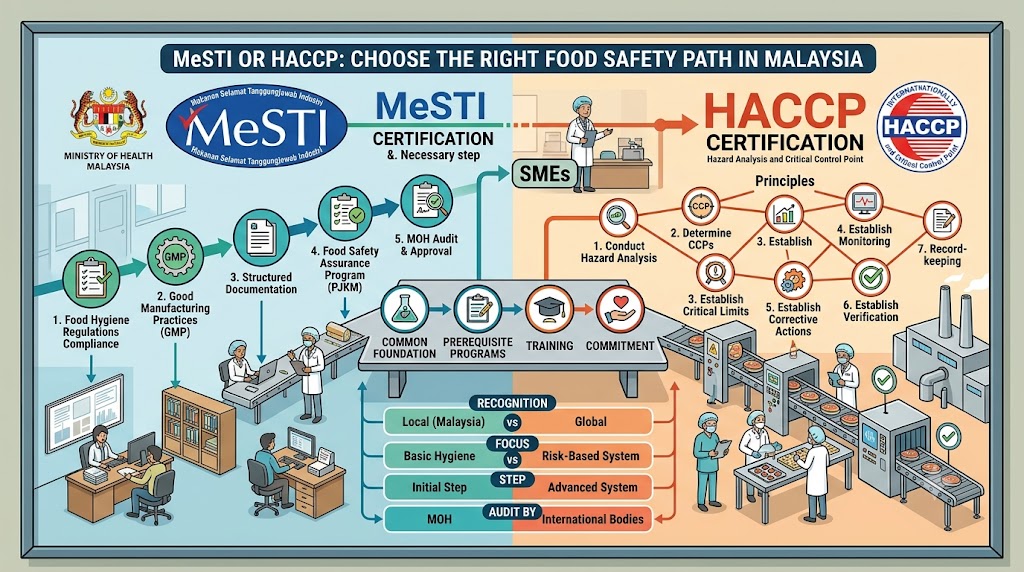
MeSTI (Makanan Selamat Tanggungjawab Industri) certification is mandatory for food manufacturers and processors in Malaysia that do not already hold a recognised food safety management system. It is a Ministry of Health scheme under the Food Hygiene Regulations 2009, and for many manufacturers it is the baseline required to supply retailers and distributors. If you produce packaged or processed food, MeSTI is usually not optional. If you’re unsure where to begin, our guide on how to get a food safety certificate explains the certification process, key requirements, and the food safety schemes available for businesses in Malaysia.
HACCP certification to MS 1480:2025, the current Malaysian HACCP standard, is the next level up. It becomes important when you supply major retailers, hotels, or institutional buyers, or when you plan to export. Larger buyers and export markets often require HACCP, or a GFSI-recognised scheme such as FSSC 22000 before they will place orders. The practical path for a growing food business is to get the legal basics in place first, adopt MeSTI or GMP, then move to HACCP or FSSC 22000 as the customer base and export ambitions grow.
Understanding the importance of HACCP can help businesses appreciate how a structured food safety system reduces risks, strengthens customer confidence, and supports long-term business growth.
What Happens If You Operate Without the Right Licences?
Operating a food business without the required licences is an offence under the Food Act 1983 and related regulations, and enforcement is active. The Ministry of Health and local authorities can issue compound fines, order the premises to close, seize food, and in serious cases pursue prosecution. Selling food online or from home does not avoid these rules. Digital and home-based sellers are subject to the same registration, licensing, and food handler requirements as a physical shop.
Beyond the legal penalties, non-compliance blocks growth. Retailers, e-commerce platforms, and institutional buyers increasingly ask for proof of MeSTI or HACCP certification before onboarding a supplier, and they will not deal with a business that cannot show a valid premises licence and food handler records. Getting the legal foundation right from the start is far cheaper than being shut down mid-operation or being disqualified from a supply contract you have already won.
Build the Legal Foundation, Then the Certification Ladder
Making a food business legal in Malaysia is a sequence, not a single licence. Register with SSM, secure your local council premises and signboard licences, register the premises in FoSIM, and make sure every food handler is trained and vaccinated, all under the Food Act 1983 and the Food Hygiene Regulations 2009. Once the legal basics are in place, MeSTI certification is the baseline for manufacturers, and HACCP to MS 1480:2025 is the standard that opens doors to major retailers and export markets. Build the foundation correctly and each step upward becomes easier.
To ensure your food safety management system aligns with the latest national requirements, read our guide on MS 1480:2025 HACCP Key Updates (Start at Jan 2026) and prepare for the latest HACCP implementation and audit expectations.
Need help implementing HACCP under MS 1480:2025? Connext can guide you.
Frequently Asked Questions About Making a Food Business Legal in Malaysia
Do I need a licence to sell food from home in Malaysia?
Yes. Selling home-cooked or home-baked food commercially requires SSM registration, a home business licence from most local councils, and a food handler certificate with typhoid vaccination. Home-based food businesses are subject to the same Food Act 1983 requirements as physical premises, and operating without a licence is an offence.
Is SSM registration compulsory for a food business?
Yes. Every food business in Malaysia must register with SSM before applying for any other licence. SSM registration gives the business a legal identity and is a prerequisite for the local council premises licence, FoSIM registration, and MeSTI certification. Local authorities will not process a premises licence without it.
Is MeSTI certification mandatory in Malaysia?
MeSTI certification is mandatory for food manufacturers and processors that do not already hold a recognised food safety management system. It is a Ministry of Health scheme under the Food Hygiene Regulations 2009. Restaurants and small food service outlets generally need premises licensing rather than MeSTI, but manufacturers usually cannot supply retailers without it.
How long is a food handler certificate valid in Malaysia?
Since a 2024 change, the food handler certificate is valid for life and does not need renewal. However, the accompanying typhoid vaccination must be renewed every three years. Both the certificate and a valid typhoid record are checked during Ministry of Health and local authority inspections.
Can I sell food online legally in Malaysia without a licence?
No. Selling food online is subject to the same rules as a physical business. You still need SSM registration, the relevant local council licence, FoSIM premises registration, and trained, vaccinated food handlers. E-commerce platforms increasingly request these documents, and selling without them is an offence under the Food Act 1983.