How to Get Food Safety Certification for Your Business
Getting a food safety certification can feel overwhelming especially if you’ve just been told it’s required to work with a client, enter a new market, or pass an audit. Most businesses don’t struggle with food safety itself, but with understanding which certification they actually need, how the process works, and how to get it done efficiently.
You might already have proper hygiene practices in place, but without a recognized certification, it can limit your ability to grow, supply larger customers, or expand internationally. This is where standards like FSSC 22000 and ISO 22000 come in but for many businesses, these terms are unfamiliar and confusing at first.
The good news is that getting certified doesn’t have to be complicated. With the right approach, you can build a compliant food safety system, pass audits confidently, and unlock new business opportunities. In this guide, we’ll walk you through everything you need to know from choosing the right certification to successfully achieving it.
What is Food Safety Certification?
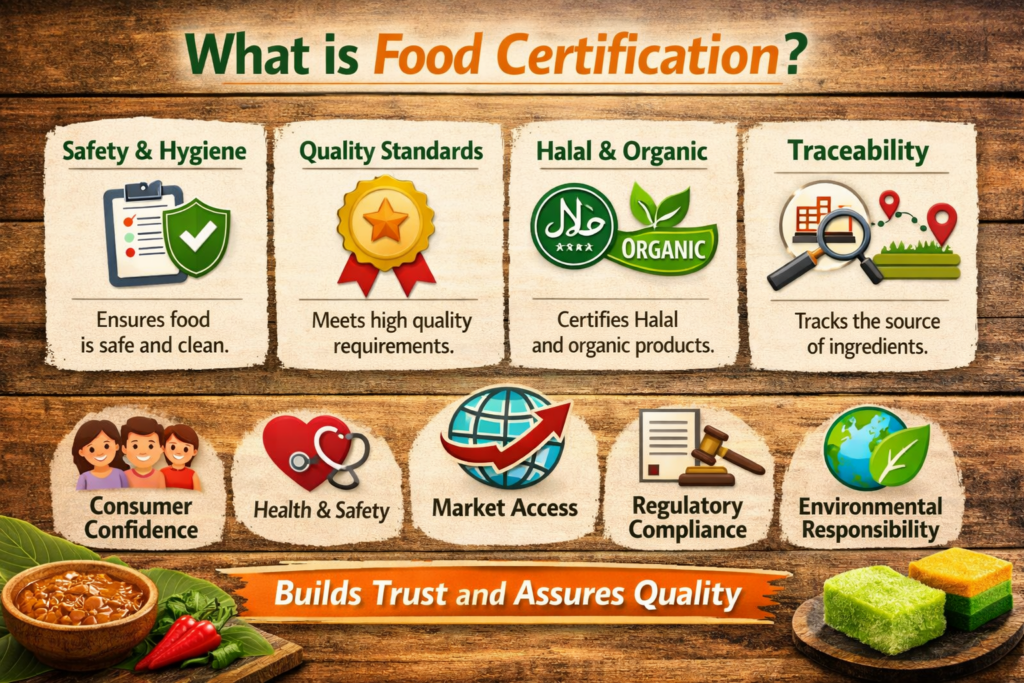
Food safety certification is a formal recognition that a business follows established standards and systems to ensure food is safe to produce, handle, store, and distribute. It shows that your company has implemented proper controls to prevent contamination, manage risks, and comply with industry or regulatory requirements.
Why Does Food Safety Certification Matter?
Food safety certification matters because it directly impacts your ability to grow, compete, and operate safely in the food industry. Without certification, many businesses face limitations not because their products are unsafe, but because they cannot formally prove their processes meet recognized standards.
Build trust and credibility with clients
First, certification builds trust and credibility. Customers, retailers, and partners want assurance that your products are consistently safe. Having a recognized certification shows that your business follows structured systems and has been independently verified.
Supply supermarkets and major brands
Second, it opens the door to larger business opportunities. Many supermarkets, international brands, and export markets require suppliers to hold certifications such as FSSC 22000 or systems based on ISO 22000. Without it, you may be excluded from these opportunities regardless of your product quality.
Meet customer or regulatory requirements
Third, it helps you reduce risks and prevent costly issues. A proper food safety system identifies potential hazards early, minimizes contamination risks, and ensures consistent control across operations. This reduces the chances of product recalls, legal issues, or damage to your brand reputation.
Enter export markets
Finally, certification supports long-term business growth and sustainability. It improves internal processes, increases efficiency, and builds a strong foundation for scaling your operations. Instead of reacting to problems, your business becomes proactive in managing food safety.
In short, food safety certification is not just about compliance, it is a strategic investment that protects your business, builds trust, and unlocks new opportunities.

Step-by-Step: How to Get Food Safety Certification
Step 1: Understand Your Requirements
The first step is to clearly understand what your business actually needs. This depends on your industry (such as manufacturing, packaging, or distribution), your target market (local or export), and whether your customers require a specific certification. Some businesses only need basic compliance, while others are required by clients to obtain internationally recognized certifications like FSSC 22000. Taking time to clarify these requirements helps you avoid choosing the wrong certification and wasting time or cost later.
Step 2: Choose the Right Certification Standard
Once you understand your requirements, the next step is selecting the appropriate certification. Smaller or local businesses may start with simpler systems, while companies aiming to supply global brands or retailers often need more advanced standards such as ISO 22000 or FSSC 22000. Choosing the right standard is critical because it determines the level of system, documentation, and audit requirements your business must meet.
Step 3: Conduct Gap Analysis
A gap analysis is used to compare your current practices with the requirements of the chosen certification. At this stage, you assess your existing food safety procedures, hygiene practices, documentation, and staff awareness to identify what is missing or needs improvement. This step provides a clear roadmap of actions required to achieve certification and helps prioritize key areas that need attention.
Step 4: Develop a Food Safety Management System (FSMS)
After identifying the gaps, you will need to develop or improve your Food Safety Management System. This includes creating policies, procedures, and records that demonstrate how your business controls food safety risks. The system typically covers hazard analysis (HACCP), prerequisite programs such as hygiene and sanitation, traceability systems, and proper documentation control. A well-structured FSMS forms the foundation for certifications like ISO 22000 and FSSC 22000.
Step 5: Implement Food Safety Controls
With the system in place, the next step is to implement it in your daily operations. This means ensuring that procedures such as cleaning, pest control, supplier management, and equipment maintenance are consistently followed by your team. Certification bodies will assess actual practices during audits, so it is important that your system is not only documented but also actively practiced within your organization.
Step 6: Train Employees
Employee training is a crucial part of the certification process. Your team must understand food safety principles, hygiene requirements, and their specific responsibilities in maintaining safe operations. Training ensures that everyone is aligned with the system and reduces the risk of human error, which is one of the most common causes of food safety issues.
Step 7: Conduct Internal Audit
Before applying for certification, you need to perform an internal audit to evaluate whether your system is working effectively. This involves reviewing processes, identifying nonconformities, and implementing corrective actions. Internal audits help you identify weaknesses early and ensure your organization is fully prepared for the external certification audit.
Step 8: Certification Audit
The final step is the certification audit conducted by an accredited certification body. This usually involves two stages: a documentation review and an on-site audit to verify implementation. If your system meets all requirements and any nonconformities are resolved, your business will be awarded food safety certification. This certification demonstrates that your organization operates according to recognized food safety standards and is ready to meet customer and regulatory expectations.
Types of Food Safety Certifications
There are several types of food safety certifications available, and the right one depends on your business size, industry, and customer requirements. While all aim to ensure food safety, they differ in complexity, scope, and global recognition.
HACCP (Hazard Analysis Critical Control Point)
HACCP is one of the most widely used food safety systems and often the starting point for many businesses.
Best for:
- Small to medium food businesses
- Companies focusing on basic food safety compliance
Key features:
- Identifies food safety hazards (biological, chemical, physical)
- Establishes Critical Control Points (CCPs)
- Focuses on prevention rather than inspection
It is sometimes required by local regulations but may not be enough for large retailers or export markets.
ISO 22000
ISO 22000 is an international standard that builds a full Food Safety Management System (FSMS). It is suitable for businesses that want a more organized and scalable food safety system.
Best for:
- Food manufacturers and processors
- Companies looking for structured systems
Key features:
- Combines HACCP principles with management system approach
- Focuses on risk-based thinking and continuous improvement
- Applicable across the entire food supply chain
FSSC 22000
FSSC 22000 is a more advanced certification based on ISO 22000, with additional requirements. This is often required by multinational companies and large retailers.
Best for:
- Companies supplying international brands or supermarkets
- Export-oriented food manufacturers
- Packaging and food supply chain businesses
Key features:
- Recognized by the Global Food Safety Initiative (GFSI)
- Includes ISO 22000 + prerequisite programs (PRPs)
- Covers food fraud, food defense, and food safety culture
- Strong global acceptance
There is latest update FSSC 22000 Version 7 that introduces stronger requirements on food safety culture, risk management, and supply chain control to further enhance global food safety standards.
GMP (Good Manufacturing Practice)
GMP focuses on maintaining basic hygiene and operational conditions. Often used together with HACCP or ISO systems.
Best for:
- Food production facilities
- Businesses needing foundational compliance
Key features:
- Clean and controlled production environment
- Equipment and facility standards
- Staff hygiene requirements
Other Industry-Specific Certifications
Depending on your market, you may also encounter Halal certification (for Muslim markets), Organic certification, BRCGS (British Retail Consortium Global Standards) and SQF (Safe Quality Food). These may be required based on customer or export market demands.
How Long Does It Take?
The time required to get food safety certification depends on your company’s size, current practices, and the type of certification you choose. For most businesses, the process typically takes between 2 to 6 months from start to certification.
Smaller companies with basic operations and some existing hygiene practices may complete the process in 2–4 months, especially if they are starting with simpler systems. On the other hand, medium to larger organizations or those aiming for advanced certifications like FSSC 22000 usually require 3–6 months or longer, as they need to implement a more comprehensive Food Safety Management System based on ISO 22000.
Several factors can affect the timeline, including how ready your current system is, how quickly documentation and implementation can be completed, the level of employee training required, and how fast any audit findings are resolved. Businesses that start with a clear plan and proper guidance often complete the process faster and with fewer delays.
Conclusion
Getting food safety certification doesn’t have to be complicated when you have the right guidance. Whether you are starting from scratch or upgrading your existing system, having a structured approach can save time, reduce risks, and ensure a smooth path to certification. Standards like FSSC 22000 and ISO 22000 can open doors to new markets, but only when they are implemented correctly and effectively.
At Connext Consulting, we specialize in ISO training and food safety certification consulting, helping businesses build practical, audit-ready systems that work in real operations, not just on paper. From gap analysis and documentation to training and certification audit preparation, our team supports you at every stage of the journey.
If you’re looking to get certified, improve your food safety system, or meet client requirements, contact Connext Consulting today and take the next step toward a safer, more competitive, and globally recognized business.
FAQs
Which food safety certification is best?
For global recognition, FSSC 22000 is one of the best options.
Do I need a consultant to get certified?
Yes. A consultant is highly recommended to speed up the process, reduce errors, and ensure full compliance with standards like FSSC 22000 and ISO 22000. Connext Consulting can support you from gap analysis to certification, making the journey faster and more efficient.