Sustainability Reporting Malaysia: How ISO 14001 Supports Your Bursa ESG Disclosure
Sustainability reporting in Malaysia is no longer just a listed company concern. As Bursa Malaysia raises its ESG disclosure requirements and supply chains cascade those expectations downward, more Malaysian businesses need to understand what sustainability reporting actually demands and how ISO 14001:2026, the international standard for environmental management, fits into that picture. This article explains exactly how ISO 14001 connects to your Bursa ESG obligations and what problem it solves.
What Is Sustainability Reporting in Malaysia?
Sustainability reporting in Malaysia is the process of disclosing a company’s environmental, social, and governance (ESG) performance to stakeholders, regulators, and the public. For Bursa-listed companies, this obligation is formalised under Paragraph 9.43 of the Bursa Malaysia Main Market Listing Requirements and the Bursa Malaysia Sustainability Reporting Guide (2nd Edition), which requires an annual sustainability statement covering material ESG risks, opportunities, and performance data.
Beyond listed companies, sustainability reporting in Malaysia is being driven by three converging pressures. The Malaysian Investment Development Authority (MIDA) has flagged ESG compliance as a factor in investment facilitation decisions. The Securities Commission Malaysia (SC) references ESG disclosures as a condition for accessing green sukuk and sustainable finance instruments. And Malaysia’s national commitment to achieve net zero greenhouse gas emissions by 2050 is translating into formal disclosure requirements across more sectors over time.
In practice, this means sustainability reporting is no longer a voluntary best practice. It is becoming a baseline requirement for any Malaysian business that wants to access capital markets, secure government contracts, or remain in the approved supplier lists of large listed companies. Learn how ISO 14001 helps you cut costs by improving resource efficiency, reducing energy consumption, minimising waste, and driving continual environmental performance improvement.
What Bursa ESG Disclosure Actually Requires
Bursa ESG disclosure requires listed companies to identify and report on material economic, environmental, and social risks and the management actions taken to address them. The Bursa Malaysia Sustainability Reporting Guide sets out mandatory disclosures and recommended indicators across three pillars: environment, social, and governance. Companies must assess materiality, set targets, track progress, and publish their findings annually.
On the environmental side, required disclosures include energy consumption, greenhouse gas (GHG) emissions by scope, water usage, and waste generation. Bursa has progressively tightened these requirements since 2015. As of the most recent update, large listed companies are required to obtain third-party assurance over their climate-related disclosures, aligned with the Task Force on Climate-related Financial Disclosures (TCFD) framework adopted by Bursa in its enhanced sustainability reporting requirements.
The practical challenge most Malaysian companies face is not knowing what to disclose. It is having a reliable, auditable system behind the numbers. Environmental data that is reconstructed from fragmented records at year-end is difficult to verify, inconsistent across reporting periods, and a clear signal to institutional investors that the company lacks mature ESG infrastructure. In our experience working with Malaysian manufacturers through their Bursa sustainability reporting cycles, the weakest section of most sustainability statements is consistently the environmental data quality, not the governance narrative.
What ISO 14001:2026 Is and What It Requires
ISO 14001:2026 is the international standard for environmental management systems (EMS), published by the International Organisation for Standardisation (ISO) and adopted in Malaysia by the Department of Standards Malaysia (DSM) as MS ISO 14001:2026. It specifies the requirements for a systematic approach to identifying, controlling, and improving an organisation’s environmental performance across its operations.
Implementing ISO 14001:2026 requires an organisation to identify its significant environmental aspects, including energy use, emissions, water consumption, and waste generation, set measurable improvement objectives, assign internal accountability for environmental controls, conduct regular internal audits, and maintain documented evidence that the system is functioning as designed. ISO 14001 certification in Malaysia is issued by accredited third-party bodies including SIRIM QAS International, SGS Malaysia, Bureau Veritas, and Lloyd’s Register Quality Assurance (LRQA) following an independent audit against the standard.
Critically, ISO 14001 does not prescribe specific environmental targets. Instead, it requires organisations to establish a robust management system for setting, monitoring, and continually improving environmental objectives. Businesses planning to implement or upgrade their EMS should also understand the ISO 14001 climate change amendment, learn ISO 14001 for SMEs where to start, and stay informed about the ISO 14001:2026 key updates and changes to ensure their environmental management system remains aligned with the latest international requirements and best practices.
How ISO 14001 Supports Sustainability Reporting in Malaysia
ISO 14001 supports sustainability reporting in Malaysia by providing the operational infrastructure that makes Bursa ESG environmental disclosures accurate, consistent, and independently defensible. Where Bursa ESG tells the market what your environmental performance looks like, ISO 14001 is the system that generates the data behind it.
Malaysian listed companies that hold ISO 14001 certification find the environmental section of their Bursa sustainability statement significantly easier to prepare. Energy and water consumption data is tracked systematically throughout the year, not estimated at year-end. GHG emission figures are derived from documented methodology aligned with the Intergovernmental Panel on Climate Change (IPCC) emission factors, not back-calculated from utility bills. Waste generation and disposal records exist in auditable form. The controls, targets, and improvement activities are already documented and verified through the ISO 14001 annual surveillance audit cycle.
For companies facing Bursa’s TCFD-aligned disclosure requirements, ISO 14001 provides the foundational data infrastructure needed to populate climate-related risk disclosures with credible, auditable metrics. Without it, companies typically spend significant internal resources trying to reconstruct environmental data under reporting deadlines, and the figures they produce are difficult to assure. Organisations should also understand environmental aspect assessment, these are the common ISO 14001 mistakes to avoid, as identifying environmental aspects incorrectly or overlooking significant impacts can lead to inaccurate ESG reporting, compliance gaps, and audit nonconformities.
ISO 14001 vs Bursa ESG Disclosure: The Key Differences
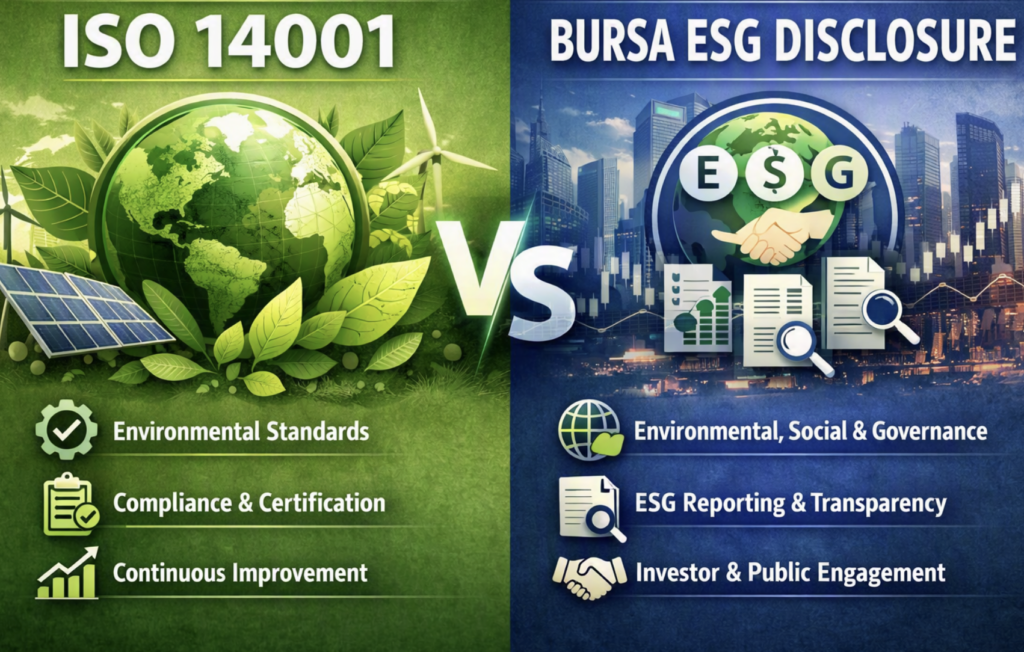
ISO 14001 and Bursa ESG disclosure are not competing requirements. They are complementary, and understanding the distinction helps you sequence what your organisation needs to do first.
- Scope. ISO 14001 covers environmental management only. Bursa ESG disclosure covers environmental, social, and governance performance together.
- Who it applies to. ISO 14001 is voluntary and available to any organisation. Bursa ESG disclosure is mandatory for Bursa-listed companies under the Main Market Listing Requirements.
- Output. ISO 14001 produces an independently issued certification valid for three years with annual surveillance audits. Bursa ESG produces an annual sustainability statement published in the company’s annual report or integrated report.
- What is audited. ISO 14001 audits your management system and documented processes. Bursa ESG disclosure requires reporting of actual environmental and social performance outcomes.
- Verification. ISO 14001 is independently audited as a condition of certification. Bursa ESG data is self-reported for most indicators, though third-party assurance on climate disclosures is now mandatory for large listed companies.
Who Should Pursue ISO 14001 Certification in Malaysia
Bursa-listed companies with material environmental exposure should treat ISO 14001 certification as the foundation of their sustainability reporting infrastructure, not an optional add-on. It is the most direct way to move from checkbox ESG reporting to credible, systems-backed disclosure that can withstand investor scrutiny and third-party assurance reviews.
Non-listed companies should pursue ISO 14001 when they supply to listed companies, bid for government contracts in environmentally regulated sectors, apply for MIDA investment incentives tied to green manufacturing, or export to markets where environmental management certification is a buyer requirement. In our experience, non-listed Malaysian manufacturers that achieve ISO 14001 certification typically report improved access to tender opportunities within 12 months of certification, particularly in contracts where ESG supplier questionnaires are part of the qualification process.
Sustainability Reporting in Malaysia Requires the Right System Behind It
ISO 14001:2015 is the operational foundation that makes Bursa ESG environmental disclosures accurate, consistent, and credible. Malaysian companies that build this system before they need it for reporting find the entire sustainability reporting process significantly less burdensome and their disclosures significantly more defensible. Those that try to build the data backwards from a reporting deadline consistently produce weaker disclosures and face greater scrutiny.
Ready to get ISO 14001 certified? Contact Connext Consulting for a free consultation.
Frequently Asked Questions
Does ISO 14001 certification satisfy Bursa ESG disclosure requirements?
No. ISO 14001:2026 covers environmental management only. Bursa ESG disclosure under the Main Market Listing Requirements also requires social and governance reporting published annually. ISO 14001 strengthens your environmental data quality but does not replace the full Bursa sustainability statement obligation.
Is sustainability reporting mandatory for non-listed companies in Malaysia?
Not yet as a formal legal requirement. However, non-listed companies supplying to Bursa-listed companies increasingly receive ESG supplier questionnaires as part of procurement qualification, making voluntary sustainability reporting a practical business necessity.
What is the difference between ISO 14001 and ISO 14064 for ESG reporting?
ISO 14001:2026 governs your overall environmental management system. ISO 14064:2018 specifically covers greenhouse gas inventory reporting and third-party verification. For Bursa ESG climate disclosures requiring TCFD alignment, ISO 14064 verification adds credibility to the emissions data specifically.
How does ISO 14001 help with TCFD-aligned sustainability disclosures?
ISO 14001:2026 builds the internal data systems for tracking energy, emissions, water, and waste throughout the year. TCFD-aligned disclosures require climate metrics supported by auditable data. ISO 14001 is the infrastructure that makes those metrics reliable rather than estimated.
How long does ISO 14001 certification take in Malaysia?
Most Malaysian organisations complete ISO 14001 certification in three to six months. Companies with existing environmental controls and documentation in place typically reach the Stage 2 audit within three months. Engaging a consultant at the start reduces the timeline and minimises non-conformity findings.