
Listeria Environmental Monitoring in Food Manufacturing Facilities
Listeria monocytogenes is the pathogen most associated with environmental monitoring programs in food manufacturing. Unlike many foodborne pathogens, it survives and multiplies at refrigeration temperatures, persists in wet processing environments, and forms biofilms that resist standard cleaning and sanitation. This guide explains why Listeria is the primary target in environmental monitoring, where to look for it, how to sample, and how to respond when you find it.
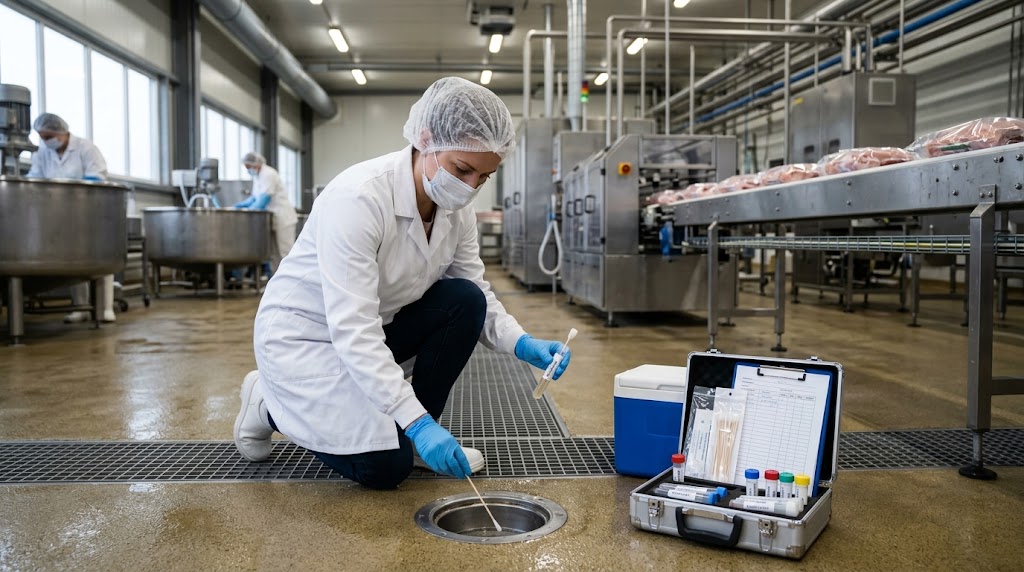
Why Is Listeria the Priority Target in Environmental Monitoring?
Most foodborne pathogens are destroyed by cooking, so they are controlled through the kill step in the process. Listeria monocytogenes is different because it commonly affects ready-to-eat (RTE) products that receive no further heat treatment after processing. If Listeria reaches the product at any point after the kill step, it will be present when the consumer eats it.
This is why Listeria environmental monitoring is a verification activity for post-lethality processing environments. You are not testing the product directly; you are testing the environment around it to confirm that your cleaning, sanitation, and hygienic zoning controls are working before contamination reaches Zone 1.
Under FSSC 22000 Version 7 Clause 2.5.7, facilities must implement a risk-based Environmental Monitoring Program that targets relevant pathogens, spoilage organisms, and indicators. For RTE facilities and chilled products, Listeria is the expected pathogen target. FSSC 22000 V7, released on 1 May 2026, strengthened the EMP requirements compared to V6, and auditors now scrutinise both the scientific basis for organism selection and the corrective action protocols.
If you are new to the overall EMP framework, our introduction to Environmental Monitoring Programs under FSSC 22000 covers the full scope of what Clause 2.5.7 requires.
Where Does Listeria Hide in Food Facilities?
Listeria thrives in cold, moist environments with organic residues. In food factories, the pathogen is most commonly found at structural joints and harborage sites where cleaning is difficult or incomplete. Understanding where Listeria persists is the foundation of any effective sampling plan.
Common harborage sites include floor-to-wall coves and junctions where condensate collects, floor drains that are improperly designed or infrequently sanitised, rubber gaskets and door seals on cold room doors and chiller units, hollow equipment frames and tubular legs that have crack welds, conveyor belt tracks and return rollers in direct-food-contact zones, overhead cable trays and pipe insulation above open product lines, and cooling or condensate drip zones from air handling units.
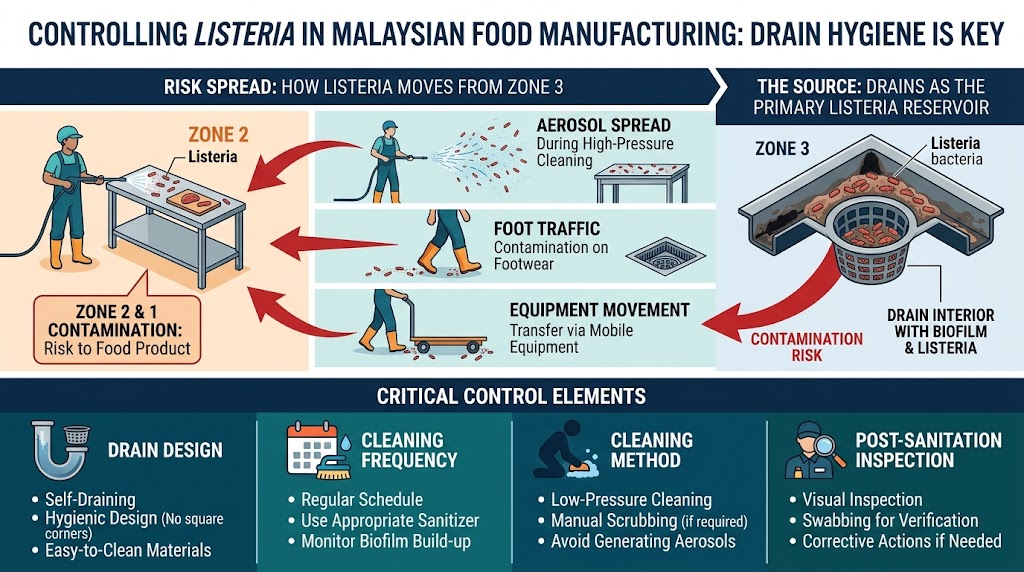
In our work with Malaysian food manufacturers, drains are consistently the most common source of Listeria-positive environmental results. A drain in Zone 3 that harbours Listeria becomes a Zone 2 and Zone 1 risk through aerosol spread during high-pressure cleaning, foot traffic, and equipment movement. This is why drain design, cleaning frequency, and post-sanitation drain inspection are critical elements of a Listeria control strategy.
Your harborage site identification should be guided by your hygienic zone map. See our guide on setting up hygienic zoning Zones 1 to 4 for how zones determine which harborage sites receive the highest sampling priority.
How Do You Sample for Listeria in Your EMP?
Listeria environmental sampling uses swabs or sponges applied to specific surfaces and then submitted to an accredited laboratory for culture-based or PCR-based analysis. The choice between swabbing for Listeria spp. (the genus) versus Listeria monocytogenes (the specific pathogen) depends on your zone and your programme objectives.
In Zones 1 and 2, sampling targets Listeria monocytogenes directly because these zones are closest to the product and a positive here has immediate food safety implications. In Zones 3 and 4, sampling typically targets Listeria spp. as an indicator of environmental contamination. A positive Listeria spp. result in Zone 3 is an early warning that the pathogen is present in the facility, even if it has not yet reached a product-contact surface.
Sampling frequency should be risk-based. A common starting framework for RTE facilities sets Zone 1 at weekly sampling, Zone 2 at monthly, Zone 3 at quarterly, and Zone 4 at semi-annual. However, a history of positive results, a recent facility layout change, or a new product launch in a higher-risk category will require increased sampling frequency until the EMP confirms control has been restored.
Sample sites should be rotated within each zone over time, not fixed to the same spots at every visit. Rotating sites gives you a broader picture of the contamination landscape and prevents you from always testing the cleanest spot in each zone. Your EMP should document the rotation schedule and explain the rationale for each site in your sampling plan.
What Happens When You Find Listeria in an Environmental Sample?
The corrective action triggered by a positive Listeria result depends on which zone the sample came from. This decision tree should be documented in your EMP before sampling starts.
A positive Listeria spp. result in Zone 4 requires investigation of the source, corrective cleaning, and repeat sampling to confirm the harborage has been eliminated. A positive in Zone 3 requires intensified sampling across Zone 3 and the adjacent Zone 2 sites, root cause analysis, targeted deep cleaning, and corrective action documentation. Monitoring frequency should be increased until a defined number of consecutive negatives restores confidence.
A positive Listeria spp. result in Zone 2 is a higher-severity event. It requires a facility-wide EMP review, intensified sampling across all zones, and a detailed root cause investigation. All cleaning and sanitation procedures for the area should be reviewed, and if the source cannot be confirmed and eliminated quickly, production in the affected line should be assessed for product safety implications.
A positive Listeria monocytogenes result in Zone 1 is a critical incident. The affected production line must be stopped, product produced since the last negative result must be held pending risk assessment, and a full corrective action including root cause investigation, deep sanitation, environmental verification, and management review is required before production resumes.
Your corrective action protocols should be aligned with your HACCP critical limit and corrective action framework, and documented as part of your food safety management system evidence for audits.
How Does Listeria Monitoring Apply Under FSSC 22000 in Malaysia?
In Malaysia, food manufacturers seeking or maintaining FSSC 22000 certification are expected to have a documented EMP that identifies the target organisms by zone, the scientific rationale for organism selection, the sampling plan with site rotation, the frequency of sampling, the laboratory methods used, and the corrective action protocol for each possible result type.
FSSC 22000 V7, which became effective on 1 May 2026, requires that EMPs be reviewed not only annually but also after any significant change to the processing environment, product portfolio, or following a positive result. Facilities transitioning from V6 to V7 should review whether their existing Listeria monitoring programme meets the strengthened requirements for documentation, scientific justification, and corrective action specificity.
Certification bodies auditing Malaysian food facilities under FSSC 22000 frequently raise non-conformities related to EMPs that lack organism rationale, have fixed sampling sites that never rotate, or have corrective action protocols that are too generic to demonstrate effective control. A well-structured Listeria environmental monitoring programme addresses all three of these areas.
If your facility is preparing for its FSSC 22000 V7 transition or initial certification, contact Connext to discuss an EMP gap assessment against the updated requirements.
Listeria environmental monitoring is not a compliance checkbox. It is the mechanism by which your facility detects contamination before it reaches the product, validates that your sanitation programme is working, and demonstrates to auditors that your food safety system is grounded in science rather than assumption. Getting your sampling plan, zone assignments, and corrective action protocols right is the difference between catching a harborage early and dealing with a food safety incident.
For an overview of FSSC 22000 certification in Malaysia and what your facility needs to put in place, visit our FSSC 22000 service page.
Frequently Asked Questions
Does every food facility need to monitor for Listeria?
Not necessarily. Listeria monocytogenes is the primary EMP target for facilities producing ready-to-eat, chilled, or frozen products with no further kill step for the consumer. Facilities producing fully cooked or high-acid products with a validated kill step may use different pathogen targets. FSSC 22000 requires organism selection to be based on a risk assessment for your specific product and process.
What is the difference between Listeria spp. and Listeria monocytogenes testing?
Listeria spp. includes all 21 species in the Listeria genus and is used as a broader environmental indicator. Listeria monocytogenes is the specific pathogen that causes listeriosis in humans. Zones 3 and 4 typically use Listeria spp. as an early warning indicator; Zones 1 and 2 test for Listeria monocytogenes due to direct product risk.
How many swab sites should we include in our EMP?
There is no fixed number. The quantity of sites is determined by your facility size, the number of zones, and your risk assessment. A small facility might begin with 10 to 15 sites per sampling event; a large complex facility may require 50 or more. The key is that every Zone 1 and Zone 2 area has adequate coverage and that sites rotate over time.
Can we do environmental monitoring in-house or do we need an external lab?
Swabbing can be done in-house by trained personnel, but the laboratory analysis should be conducted by an accredited laboratory using validated methods (ISO 11290 for culture or validated PCR equivalents). In-house analysis requires method validation and proficiency testing, which most food manufacturers are not equipped to maintain.
How long do we need to keep EMP records for FSSC 22000?
FSSC 22000 requires records to be retained for at least the shelf life of the product plus one year, or a minimum of one year, whichever is longer. In practice, most Malaysian facilities retain EMP records for three to five years to support trend analysis and audit evidence requirements.