
How Production Planning and Control Works in Malaysian Manufacturing
Production planning and control is how manufacturers decide what to make, when to make it, and with what resources, then monitor whether the plan is being followed. Done well, it reduces material waste, improves on-time delivery, and gives you reliable data for quality and management reviews. Under ISO 9001, operational planning and control is a formal requirement under Clause 8, not just a management best practice.
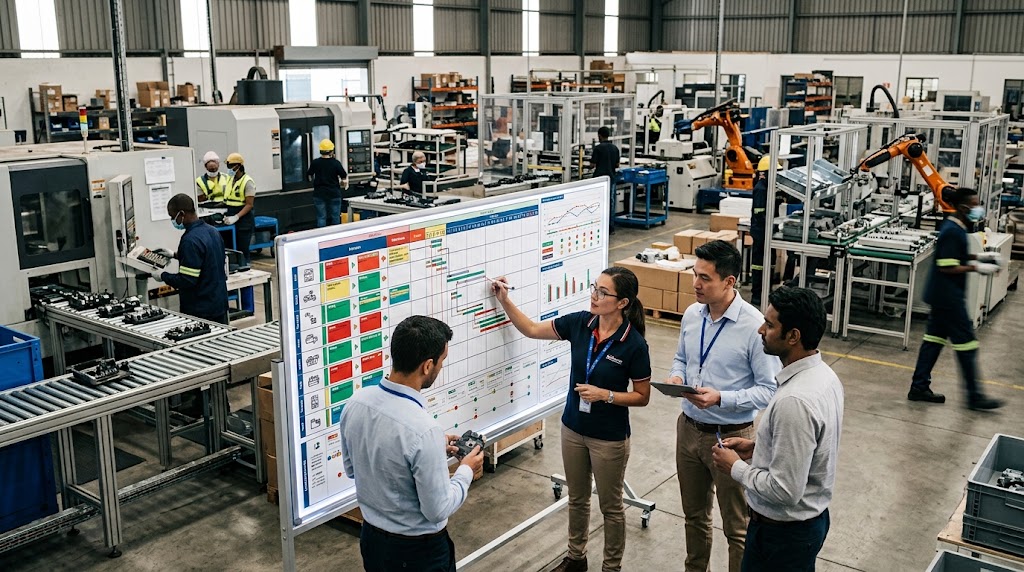
What Is Production Planning and Control?
Production planning determines what to produce, in what quantity, at what time, and using what materials, equipment, and labour. It translates customer orders and demand forecasts into a schedule that organises production efficiently. A good production plan reduces idle time, avoids material shortages, and prevents the bottlenecks that drive up overtime and delay deliveries.
Production control is the monitoring function that runs alongside the plan. It tracks whether production is on schedule, flags deviations, and initiates corrective action. Together, planning and control form a closed loop: plan, execute, monitor, correct.
ISO 9001 Clause 8 governs operational planning and production control in detail. For a clause-by-clause explanation, see our guide to ISO 9001 requirements explained.
The Key Steps in Production Planning and Control
- Planning: Defines what will be produced, the sequence of operations, the materials required at each stage, and how long each task will take. Inputs include confirmed orders or demand forecasts, bills of materials, equipment capacity data, and available labour. Under ISO 9001, planning must also account for quality controls at each production stage and the risk of not meeting customer requirements.
- Routing and loading: Translates the plan into a schedule. Routing determines the path materials take through your facility, from raw input to finished product. Loading assigns work to each routing point based on available capacity. This step makes bottlenecks visible before production starts, so adjustments can be made proactively.
- Production and dispatch: Releases work orders to the floor and confirms that materials, tools, and instructions are in place at each workstation. ISO 9001 Clause 8.5.1 requires production to run under controlled conditions: documented work instructions available at the point of use, capable and maintained equipment, and defined monitoring activities at critical stages.
- Follow-up and monitoring: Checks that production is progressing according to plan. This involves tracking work-in-progress at each stage, identifying delays or quality issues, and communicating deviations to planning so the schedule can be adjusted. Under ISO 9001 Clause 9.1, the data collected here feeds into management review and performance analysis.
- Inspection and correction: Products are checked against specifications before release, and any nonconformances trigger root cause analysis and corrective action under ISO 9001 Clause 10.2. The results feed back into planning improvements for the next production cycle.
The Benefits of Production Planning and Control
- Lower inventory costs: Planning that calculates material requirements accurately means you avoid holding excess buffer stock, reduce storage costs, and lower the risk of materials becoming obsolete when product requirements change.
- Better delivery performance: Realistic scheduling directly improves on-time delivery. Malaysian manufacturers supplying automotive, electrical and electronics, and food processing buyers are typically assessed on delivery rates. A documented production schedule with tracked delivery data satisfies both the ISO 9001 monitoring requirement and what supply chain buyers expect to see at supplier qualification audits.
- Reduced waste: When processes are planned and monitored systematically, nonconformances are caught earlier, rework is reduced, and the root causes of recurring quality failures are addressed through corrective action rather than accepted as normal.
How ISO 9001 Supports Production Planning and Control in Malaysia
- Documented framework: ISO 9001 requires documented production processes, defined monitoring activities, calibrated measuring equipment, and a corrective action process for quality failures. These requirements create the structure that makes production planning and control systematic and auditable.
- Audit-ready evidence: In our work with Malaysian manufacturers, the most consistent difference between operations with and without ISO 9001 is the presence of documented controls and the discipline to maintain them. Written work instructions, calibration records, and a corrective action log are the evidence base that GLC procurement teams, export buyers, and certification auditors look for when qualifying suppliers.
- Integrated management: Combining ISO 9001 with ISO 45001 covers both quality and safety controls within a single Integrated Management System, reducing the documentation burden and making supplier audits easier to prepare for.
For production environments that also need to manage energy use, waste, or emissions, ISO 14001 environmental management certification can be added to the same integrated framework alongside ISO 9001 and ISO 45001.
See our overview of ISO 45001 occupational health and safety certification in Malaysia for manufacturers looking to manage production safety risks alongside quality.
Effective production planning and control comes down to clear processes, reliable data, and a system for acting on what the data shows. ISO 9001 provides the documented framework. What you build inside it determines how well your production environment actually performs.
Contact Connext to discuss how ISO 9001 certification in Malaysia can support your production planning and control processes.
Frequently Asked Questions
Is production planning and control only for manufacturers?
No. The principles apply to any organisation delivering a product or service to a schedule. For service businesses, the equivalent covers project planning, resource allocation, and service delivery monitoring. ISO 9001 Clause 8 applies to both manufacturers and service providers.
Which ISO 9001 clauses cover production planning?
Clause 8.1 covers operational planning and control. Clause 8.5 covers production and service provision under controlled conditions. Clause 8.6 governs product release. Clause 9.1 requires monitoring and measurement of production performance. Clause 10.2 covers corrective action when production quality fails.
How should unplanned changes to a production schedule be handled?
Under ISO 9001 Clause 8.1, planned changes must be controlled. For unplanned changes, the organisation should document what changed, assess the impact on delivery and product quality, communicate to affected parties, and update the risk register if the change introduces new risks.
What is the difference between production planning and quality control?
Production planning determines what will be produced, when, and with what resources. Quality control monitors whether what is being produced meets specifications. Both are required under ISO 9001, and both feed into management review and continual improvement.
How does ISO 9001 certification help with production control in Malaysia?
ISO 9001 requires documented production controls, calibrated equipment, trained personnel, and a corrective action process. This evidence base is required for MOF contractor registration, GLC supplier qualification, and export market buyer audits. Certification shows customers that your production control is systematic, not informal.