What Is Quality Inspection and Why Does It Matter for Malaysian Manufacturers?
Quality inspection is how manufacturers verify that products meet defined requirements before they reach customers. It happens at multiple points in the production process, from raw material receipt to final release, and it is a documented requirement under ISO 9001. For Malaysian manufacturers supplying into export markets, getting quality inspection right is increasingly tied to maintaining supplier qualification status with international buyers.
What Is the Quality Inspection Process?
Quality inspection is a step-by-step process of checking that products conform to specified standards at each stage of production. The steps typically include defining quality criteria, specifying inspection methods and acceptance limits, deciding on sample size or 100 percent inspection, carrying out the checks, documenting results, and initiating corrective action where defects are found.
Under ISO 9001, Clause 8.6 requires that no product be released to a customer until all planned inspection activities are completed and the release is authorised by a named person. Clause 7.1.5 requires that measuring equipment be calibrated and that calibration records are kept. These are not optional: an inspection activity that leaves no documented evidence does not satisfy ISO 9001 requirements, and auditors will ask for records at every audit cycle.
For a full explanation of what ISO 9001 Clause 8 requires across operational planning, production, and release of products, see our guide to ISO 9001 requirements explained.
Why Does It Matter for Malaysian Manufacturers?
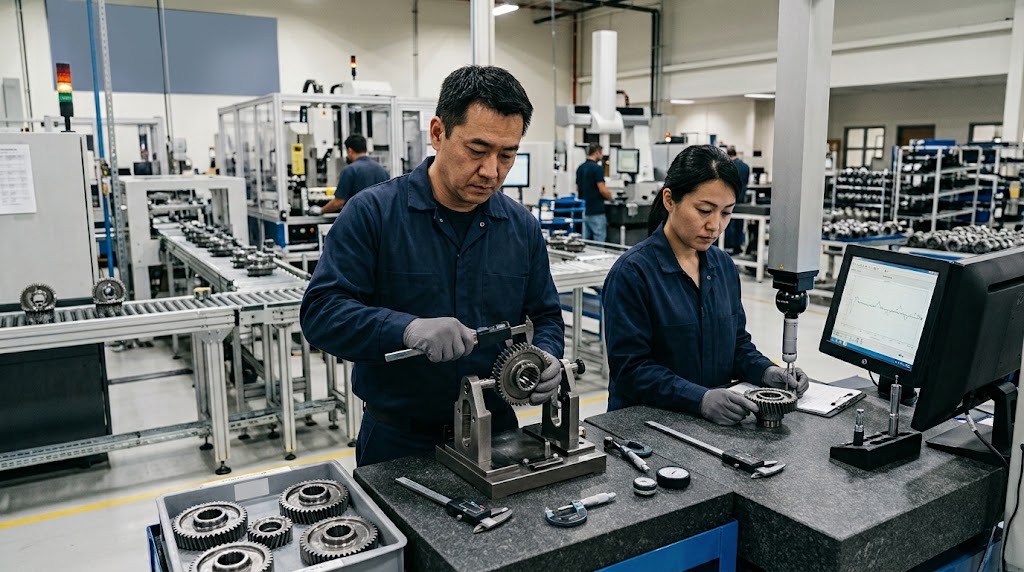
Quality inspection helps Malaysian manufacturers reduce defective products, minimise rework, and prevent nonconforming goods from reaching customers. Without consistent inspection procedures, businesses may face higher production costs, customer complaints, delivery delays, and potential damage to their reputation.
For manufacturers supplying multinational companies or export markets, quality inspection also helps demonstrate that products meet agreed specifications and applicable regulatory requirements. Implementing ISO 9001 can strengthen this process by establishing clear inspection criteria, maintaining records, and requiring organisations to address nonconformities systematically.
By combining effective quality inspection with continual improvement, Malaysian manufacturers can improve product consistency, control waste, and build stronger customer confidence.
What Are the Main Types of Quality Inspection?
Quality inspection happens at three main stages, each with a specific purpose in the production process.
- Incoming inspection (IQC): Checks raw materials and components from suppliers before they enter production. Catching a defective material at this stage costs far less than discovering it after the product is assembled. ISO 9001 Clause 8.4 requires organisations to control what they receive from external providers. The extent of incoming inspection should reflect the supplier’s track record and the criticality of the material.
- In-process inspection: Occurs at defined checkpoints during manufacturing. These checks catch deviations while rework is still relatively simple and inexpensive. Work instructions under ISO 9001 Clause 8.5 should specify where these checks occur, what is checked, and what the acceptance criteria are.
- Final inspection: The last quality gate before a product ships. It verifies that the finished product meets all requirements including function, dimensions, labelling, and packaging. In regulated industries such as electrical and electronics, automotive components, and medical devices, final inspection may also involve third-party testing by an accredited body such as SIRIM QAS International.
What Are the Fundamental Principles of Quality Control?
- Prevention over correction: The foundation of ISO 9001 quality thinking. The goal is to build controls into the process that stop defects from forming, rather than relying on inspection to catch them after the fact. An organisation that finds most of its defects at final inspection has already incurred the full production cost of those defects.
- Standardisation: Ensures every inspector applies the same criteria to the same product. Documented inspection checklists, calibrated gauges, and trained inspectors following written procedures are what make results consistent and comparable over time.
- Continual improvement: Required under ISO 9001 Clause 10. Quality inspection data should feed back into the system. A recurring defect type should trigger a root cause investigation and corrective action, not just be counted and filed. Inspection data that is collected but never analysed is one of the most common gaps in Malaysian QMS implementations.
How ISO 9001 Supports Quality Inspection in Malaysia
1. Establishes Standardised Inspection Procedures
ISO 9001 helps manufacturers establish consistent quality inspection procedures for incoming materials, in-process production, and finished products. By defining inspection criteria, acceptance limits, and responsibilities, businesses can reduce inconsistent checks and identify defects before products reach customers.
2. Improves Defect Control and Corrective Actions
ISO 9001 requires organisations to address nonconformities and take appropriate corrective action. When an inspection identifies a defect, manufacturers can investigate its root cause, implement corrective measures, and monitor whether the problem recurs. This helps reduce repeated defects, rework, material waste, and customer complaints.
3. Strengthens Inspection Records and Traceability
Maintaining documented inspection results provides evidence that products meet specified quality requirements. Malaysian manufacturers can use these records to trace recurring quality issues, support customer audits, and demonstrate conformity with applicable requirements.
4. Drives Continual Improvement
ISO 9001 encourages businesses to analyse inspection data, monitor quality performance, and identify opportunities to improve production processes. By tracking defect rates, rejection rates, and customer complaints, manufacturers can make informed decisions to improve product consistency and operational efficiency.
For manufacturers that also need to address environmental compliance alongside quality, ISO 14001 environmental management certification can be integrated with ISO 9001 into a combined management system.
Quality inspection is most effective when it is part of a systematic quality management framework, not a standalone activity at the end of the production line. ISO 9001 creates the documented controls, trained personnel, and improvement discipline that make inspection consistent and auditable over time.
Contact Connext to discuss how ISO 9001 certification in Malaysia can support your quality inspection system and give your customers and auditors the evidence they need.
Frequently Asked Questions
Is quality inspection the same as quality control?
No. Quality control is the broader system that includes process monitoring, data analysis, calibration, and corrective action. Quality inspection is one component of quality control: the physical activity of checking products at defined stages.
What does ISO 9001 require for product inspection?
ISO 9001 Clause 8.6 requires that products not be released until all planned inspection arrangements are completed, with documented evidence retained. Clause 7.1.5 requires measuring equipment to be calibrated. Clause 8.7 governs what happens to products that fail inspection.
How should quality inspection results be documented?
Each inspection should produce a record showing: what was inspected, the criteria applied, the results, any defects found, and who authorised the release or rejection. Records must be controlled under ISO 9001 Clause 7.5 and retained for the period your QMS specifies.
What happens when a product fails quality inspection?
Nonconforming products must be controlled under ISO 9001 Clause 8.7 to prevent unintended use or delivery. Options include rework, scrapping, release under authorised concession, or return to supplier. The disposition and the reason for it must be documented.
Does ISO 22000 also require quality inspection?
ISO 22000 covers food safety monitoring and verification at critical control points. Manufacturers with both ISO 9001 and ISO 22000 certification typically integrate incoming, in-process, and final inspection into a single system to avoid duplicating records and processes.