What Is ISO Risk and Opportunity Assessment and How Does It Work in Malaysia?
Every ISO management standard requires you to identify what could go wrong and what could go right before it happens. This is what risk and opportunity assessment is: a structured planning process built into ISO 9001, ISO 14001, ISO 45001, ISO 22000, and ISO 50001 under Clause 6.1. Getting it right is one of the first things an auditor will check.
What Is ISO Risk and Opportunity Assessment?
Risk and opportunity assessment is the process of identifying factors that could affect your organisation’s ability to achieve its management system objectives, then planning what to do about them. Risks are things that could go wrong. Opportunities are conditions that, if acted on, could improve performance, open new markets, or reduce costs.
Under ISO 9001:2026, Clause 6.1 was restructured into three subclauses: 6.1.1 for the overall requirement, 6.1.2 for managing risks, and 6.1.3 for pursuing opportunities. This is a notable change from ISO 9001:2015, where both were addressed together. If your QMS currently uses a combined register without a clear distinction, that will likely draw a finding at your transition audit.
For a full breakdown of what changed in ISO 9001:2026 including the Clause 6.1 restructure, see our article on ISO 9001:2026 key changes for Malaysian businesses.
How to Identify Risks in Your ISO Management System
Risk identification starts with your context analysis. The internal and external issues you documented under Clause 4.1, and the interested-party requirements under Clause 4.2, are the main inputs. Common tools include SWOT analysis for mapping strengths and vulnerabilities, and PESTLE for external factors like regulatory changes, supply chain shifts, or climate-related risks (which ISO 9001:2026 now explicitly names as an external issue to consider).
One point that often causes confusion: ISO risk and opportunity assessment is not the same as HIRARC. HIRARC is a safety-specific tool used to identify hazards, assess risks, and determine control measures under Malaysian occupational safety and health practices. ISO 9001 risk assessment operates at the quality management system level, covering business risks such as supplier failures, process quality issues, or changes in customer requirements. Both may exist in an integrated management system, but they serve different purposes. Similarly, quality policy and quality objectives in ISO 9001 help organisations establish their quality commitments and measurable targets to address relevant risks and opportunities.
How to Recognise and Pursue Opportunities
Opportunities are the positive side of your context analysis. They might include growing demand from buyers requiring certified suppliers, new technology that reduces your defect rate, or a regulatory change that gives certified businesses a competitive edge in government procurement. ISO 9001:2026 Clause 6.1.3 now requires a documented action plan specifically for opportunities, separate from the risk register. Each opportunity should have a planned action, a responsible person, a timeline, and a measure of success.
Organisations seeking ISO 45001 to manage workplace safety risks alongside their QMS will find that ISO 45001 occupational health and safety certification uses the same Clause 6.1 framework within the safety context.
How to Assess and Prioritise Risks
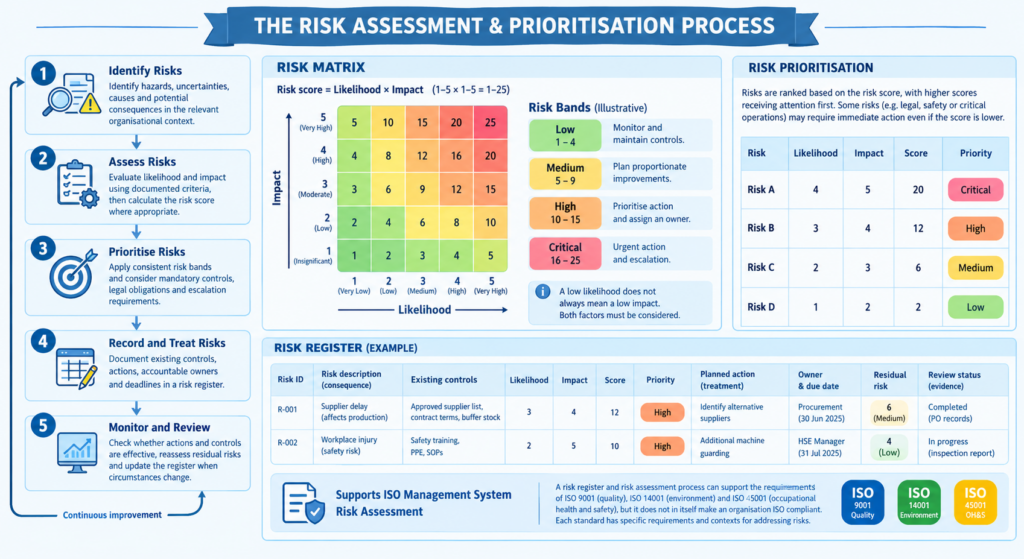
Once risks are identified, assess them using a risk matrix that scores likelihood and impact on a defined scale (typically 1 to 5 for each). Multiplying the two scores gives a risk rating you can use to prioritise action. ISO standards do not prescribe a specific tool or format, so a well-maintained spreadsheet works as long as it captures the risk, the assessment scores, the action planned, who is responsible, and whether the action was effective.
In our work with Malaysian manufacturers and service businesses, the most common gap is not failing to identify risks but failing to document the assessment and follow up on actions. Auditors from SGS Malaysia, Bureau Veritas Malaysia, TUV SUD Malaysia, and LRQA Malaysia consistently look for a risk register that shows what was done, by whom, and whether it worked.
How Risk and Opportunity Assessment Connects to Your Wider QMS
Risk and opportunity assessment is not a standalone document. It feeds into quality objectives (Clause 6.2), operational planning (Clause 8.1), and management review (Clause 9.3). Understanding what QMS covers under ISO 9001 helps organisations see how risk-based thinking connects to these processes and supports continual improvement. Under ISO 9001:2026, Clause 9.3.2 requires management review to include the effectiveness of actions taken on risks and opportunities as separate agenda items. Management review minutes should reflect that both were discussed, with evidence of what was reviewed and what decisions were made.
A risk register prepared for the initial certification audit and never updated after that is a recurring finding in recertification audits. Reviews should happen at planned intervals and whenever significant changes occur in your business context, such as a new supplier, a new regulatory requirement, or a major operational change.
For organisations combining quality, environmental, and safety management, see how ISO 14001 environmental management certification applies the same Clause 6.1 framework to environmental risks and opportunities.
Risk and opportunity assessment works best when it is genuinely connected to how your organisation makes decisions, not just a document that gets updated before audits. Start with your context analysis, keep your register current, and make sure leadership is reviewing the outcomes at management review.
Contact Connext to discuss how to build a practical, audit-ready risk and opportunity process as part of your ISO 9001 certification in Malaysia.