
What Is an Environmental Monitoring Program in Food Safety? A Guide for FSSC 22000
An environmental monitoring program (EMP) is a structured, risk-based plan for collecting and testing samples from a food manufacturing environment to detect the presence of pathogens, spoilage organisms, or indicator organisms before they reach the product. Under FSSC 22000 Clause 2.5.7, an environmental monitoring program is a mandatory additional requirement for certified organisations. For Malaysian food manufacturers producing ready-to-eat products, chilled or ambient-stable foods, or products for export markets with strict microbiological specifications, a well-designed EMP is one of the most important verification tools in the food safety management system.
What Is an Environmental Monitoring Program and Why Is It Required Under FSSC 22000?
An environmental monitoring program is a verification activity. It does not control contamination directly; instead, it verifies that your prerequisite programmes, including cleaning and sanitation, pest control, hygienic zoning, and personnel hygiene practices, are working as intended. FSSC 22000 Clause 2.5.7 makes an EMP a mandatory requirement for all certified organisations that produce food in categories where environmental pathogens pose a risk, including ready-to-eat food manufacturers, processors of chilled products, and handlers of post-process plant products.
The rationale is straightforward, cleaning and sanitation PRPs cannot be fully validated by visual inspection alone. Environmental monitoring provides objective, testable evidence that cleaning is effective, that sanitation chemicals are performing as specified, that hygienic zones are not being breached, and that environmental pathogens have not established persistent harborage sites within the facility.
FSSC 22000 Version 6 expanded the scope of Clause 2.5.7 to include pre-process handling of plant products, covering activities that do not alter the original whole form of the product. This means Malaysian food manufacturers handling raw plant-based ingredients before processing are now within scope for environmental monitoring requirements, not only manufacturers of finished ready-to-eat products.
Effective environmental monitoring can also help manufacturers identify hygiene and process issues that may contribute to food waste, reducing the risk of contaminated products being rejected, discarded, or recalled.
What Does FSSC 22000 Clause 2.5.7 Require in an Environmental Monitoring Program?
FSSC 22000 Clause 2.5.7 requires a documented environmental monitoring program that takes a risk-based approach to sampling. The program must address three categories of target organisms, pathogens relevant to the product and process, spoilage organisms where relevant, and hygiene indicator organisms. Which organisms are included must be determined by risk assessment: if a pathogen is identified as relevant to your facility or product type, it must be included in monitoring.
The mandatory elements of a documented EMP under Clause 2.5.7 include:
- A risk assessment identifying which environmental pathogens and indicator organisms are relevant to the facility, product categories, and food chain category
- Defined sampling locations in each hygienic zone, with rationale for site selection based on risk and historical data
- Sampling frequency for each location and organism, proportionate to the risk level of the zone and the organism
- Defined testing methods, including method validation or reference to accredited laboratory methods
- Acceptance criteria and action limits, distinguishing between results that trigger enhanced cleaning only and results that trigger product hold or recall assessment
- Corrective action procedures, including source tracing, enhanced cleaning and re-testing, and escalation for confirmed pathogen detections
- Trend analysis and data review at defined intervals
- Annual review of the full program, plus trigger-based reviews when specified conditions occur
The program must comply not only with FSSC 22000 requirements but also with applicable legislation and customer requirements for microbiological monitoring. For Malaysian food manufacturers exporting to international markets, customer-specific EMP requirements from global retail buyers and food service companies are often more prescriptive than the Clause 2.5.7 baseline, particularly regarding Listeria monitoring frequency and corrective action protocols for positive results.
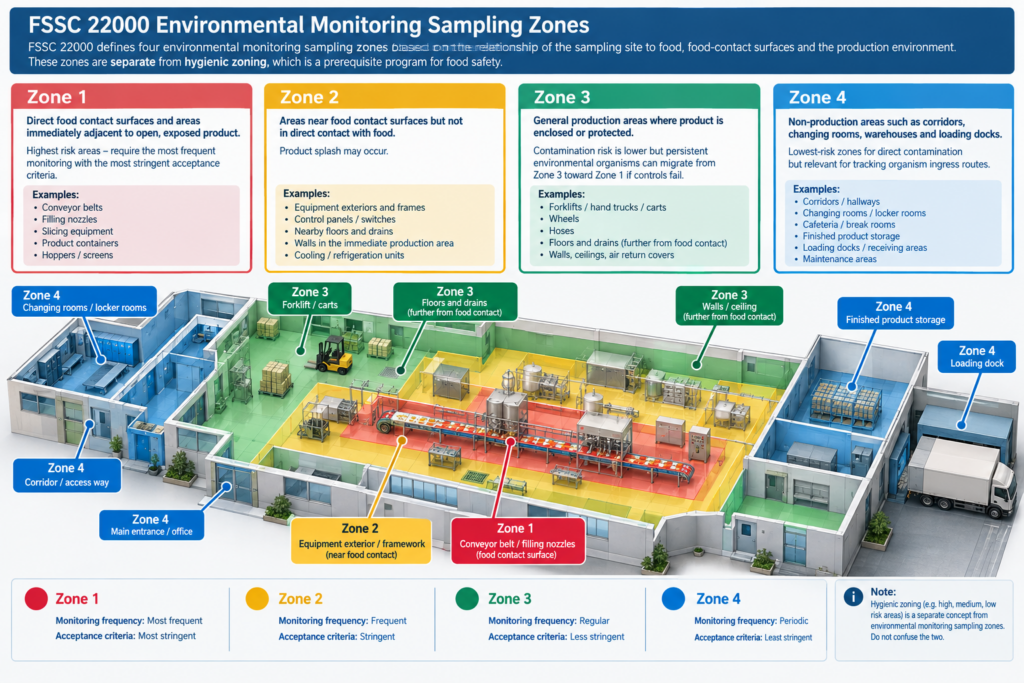
How Does Hygienic Zoning Work and How Does It Shape an Environmental Monitoring Program?
Hygienic zoning is the physical and procedural separation of a food manufacturing facility into areas with different contamination risk levels. Zoning is a prerequisite to environmental monitoring, not a component of it: it defines the structure that the EMP samples against. Understanding zoning is as fundamental to environmental safety as the seven HACCP principles are to hazard control in a food safety management system.
FSSC 22000 environmental monitoring guidance recognises four hygienic zones:
- Zone 1: Direct food contact surfaces and areas immediately adjacent to open, exposed product. These are the highest-risk areas and require the most frequent monitoring with the most stringent acceptance criteria. Examples: conveyor belts, filling nozzles, slicing equipment, product containers.
- Zone 2: Areas near food contact surfaces but not in direct contact with food. Product splash may occur. Examples: equipment frames, nearby floors and drains, walls in the immediate production area.
- Zone 3: General production areas where product is enclosed or protected. Contamination risk is lower but persistent environmental organisms can migrate from Zone 3 toward Zone 1 if controls fail.
- Zone 4: Non-production areas such as corridors, changing rooms, warehouses, and loading docks. These are the lowest-risk zones for direct contamination but are relevant for tracking organism ingress routes.
Sampling locations in your EMP should be selected to capture all four zones, with sampling weighted toward Zones 1 and 2. Zone 3 and 4 monitoring provides early warning, detection of a pathogen in Zone 3 before it reaches Zone 1 gives the facility time to respond with enhanced cleaning before product contamination occurs.
What Organisms Should a Malaysian Food Manufacturer Target in Environmental Monitoring?
The target organisms in an EMP depend on the food chain category, the products manufactured, and the outcome of the hazard analysis. ISO 22000:2018, which underpins the FSSC 22000 scheme, requires that all relevant biological hazards are identified through hazard analysis. The EMP target organisms should be derived from this analysis rather than selected generically.
For Malaysian food manufacturers, the most common target organisms by product category are:
- Ready-to-eat meat, seafood, dairy, and deli products: Listeria monocytogenes is the primary environmental pathogen target, with Listeria spp. used as a broader indicator. Enterobacteriaceae and Total Viable Count (TVC) are used as hygiene indicators in Zone 1 and Zone 2.
- Low-moisture and dry products (spices, nut-based products, dried snacks, confectionery, cereals): Salmonella spp. is the primary environmental pathogen target. Aerobic Plate Count (APC) and Enterobacteriaceae serve as hygiene indicators.
- Fresh produce and minimally processed plant products: Listeria spp. and generic E. coli are primary targets. Total coliform counts serve as indicators of sanitation effectiveness.
- Ambient-stable packaged foods and beverages: spoilage organism monitoring (yeast and mould counts) becomes more relevant alongside pathogen monitoring.
In our work with Malaysian food manufacturers preparing for FSSC 22000 certification, the most common EMP gap is a program that monitors only hygiene indicators and does not include pathogen-specific testing. An indicator result of zero does not confirm absence of pathogens, Listeria monocytogenes, in particular, can persist in environmental harborage sites in low numbers that do not trigger indicator alerts. FSSC 22000 Clause 2.5.7 requires pathogen monitoring where relevant; for RTE manufacturers, it is invariably relevant.
When Must an Environmental Monitoring Program Be Reviewed or Updated?
FSSC 22000 Clause 2.5.7 requires an environmental monitoring program to be reviewed at least annually as part of the food safety management system review. The annual review should assess whether the sampling locations, frequencies, target organisms, and acceptance criteria remain appropriate given current products, processes, and facility conditions.
Beyond the annual review, Clause 2.5.7 requires the EMP to be reviewed when any of the following trigger events occur:
- Changes in products, ingredients, processes, equipment, facility layout, or applicable legislation
- Positive test results for pathogens in any zone of the facility
- Extended periods of elevated indicator organism counts, even if below the action limit for pathogen testing
- Out-of-specification microbiological results in intermediate or finished products that may be linked to environmental contamination
- Detection of pathogens in the facility environment, regardless of whether product was affected
- Product alerts, recalls, or withdrawals where environmental contamination was a contributing factor
A triggered review is not the same as a corrective action. Corrective action responds to the specific positive result, source trace, enhanced clean, re-test, product hold where indicated. The triggered review assesses whether the EMP itself is adequate whether sampling frequency was sufficient to detect the harborage site, whether the correct zones were being sampled, and whether the corrective action procedure functioned as designed.
Auditors reviewing environmental monitoring programs under FSSC 22000 will specifically check for trend data and evidence of triggered reviews. A program with no positive results and no trend data is not evidence of a clean facility, it may indicate insufficient sampling frequency or method sensitivity. Auditors expect to see that the program is calibrated to detect issues rather than simply to avoid finding them.
Organisations preparing for a food safety audit should ensure their environmental monitoring programme includes documented sampling plans, trend analysis, defined response criteria, and evidence of follow-up actions.
An EMP Is Verification That Your Controls Are Working, Not Evidence That Problems Do Not Exist
A well-designed environmental monitoring program under FSSC 22000 Clause 2.5.7 maps your facility by hygienic zone, targets the pathogens and indicators that matter for your product category, samples at frequencies proportionate to risk, and responds with documented corrective actions and triggered reviews when results warrant it.
Malaysian food manufacturers that treat the EMP as a compliance checkbox rather than a genuine verification tool will find it fails precisely when it matters most, at audit, after a recall, or when a persistent harborage site produces a cluster of out-of-spec finished product results that should have been anticipated by Zone 2 and Zone 3 monitoring trends.
Ready to design or strengthen your environmental monitoring program for FSSC 22000 certification? Contact Connext Consulting for a free consultation.
Frequently Asked Questions
What is an environmental monitoring program in food safety?
An environmental monitoring program (EMP) is a documented, risk-based plan for testing surfaces, equipment, air, water, and other environmental samples in a food manufacturing facility to detect pathogens, spoilage organisms, or hygiene indicators before they reach the product. Under FSSC 22000 Clause 2.5.7, it is a mandatory verification activity.
What clause in FSSC 22000 covers environmental monitoring?
Environmental monitoring is covered under FSSC 22000 Clause 2.5.7, which is an additional requirement above and beyond ISO 22000:2018. It requires a documented, risk-based environmental monitoring program covering pathogens, spoilage organisms, and indicators relevant to the facility and product category.
What is hygienic zoning and how does it relate to environmental monitoring?
Hygienic zoning divides a food manufacturing facility into four zones based on contamination risk: Zone 1 (direct food contact), Zone 2 (areas near food contact), Zone 3 (general production), and Zone 4 (non-production areas). Zoning defines where EMP samples are collected and how frequently, with Zones 1 and 2 requiring the most intensive monitoring.
What organisms should be targeted in an environmental monitoring program?
Target organisms depend on the product category. Ready-to-eat and chilled product manufacturers typically target Listeria monocytogenes and use Listeria spp. and Enterobacteriaceae as indicators. Low-moisture product manufacturers target Salmonella spp. Fresh produce handlers target E. coli and coliforms. FSSC 22000 requires pathogen-specific monitoring where relevant, not indicators alone.
How often should an environmental monitoring program be reviewed?
FSSC 22000 Clause 2.5.7 requires an annual review as a minimum. Additional triggered reviews are required when positive pathogen results occur, when indicator trends are elevated, when products, processes, or legislation change, or when a product recall or withdrawal linked to environmental contamination takes place.