ISO 14001:2026 in Malaysia: Key Updates & Changes
For Malaysian businesses, environmental compliance has moved from a back-office concern to a boardroom priority. Bursa Malaysia’s enhanced sustainability disclosures, EU buyers asking about CBAM exposure, and the steady rollout of NETR commitments all point in the same direction. ISO 14001:2026, published in April 2026, replaces the eleven-year-old 2015 edition and arrives just as that pressure peaks. This guide walks Malaysian organisations through what has changed, the deadline you cannot miss, and how to plan a transition that strengthens your business rather than draining it.
ISO 14001:2015 vs 2026: What Has Actually Changed?
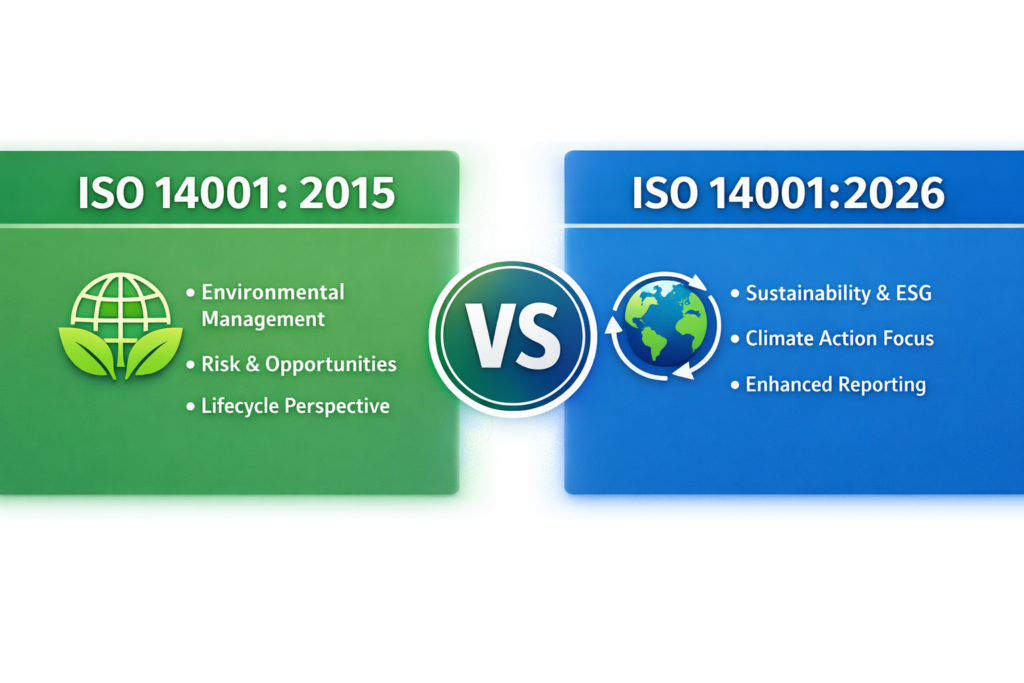
If you are already certified, the bones of the standard are intact. The Annex SL high-level structure, the Plan-Do-Check-Act cycle, and the ten-clause framework all remain. ISO themselves describe the revision as “evolution, not revolution.”
The substantive shifts in ISO 14001:2015 vs 2026 cluster around five themes:
- Clause 4 now explicitly names climate change, biodiversity, ecosystem health, pollution, and natural resource availability as conditions every organisation must evaluate
- A new Clause 6.3 introduces formal change management requirements
- “Outsourced processes” has been broadened to “externally provided processes, products, and services”, expanding supply-chain accountability
- Leadership accountability extends downward to all relevant roles, not just senior management
- Management review is restructured into three sub-clauses, and internal audits must now have defined objectives
No 2015 requirements have been removed. The revision tightens, clarifies, and modernises rather than rewriting the standard from scratch.
What Is Clause 6.3 in ISO 14001:2026?
Of all the updates, Clause 6.3 Planning of Changes is the only genuinely new clause and the one most likely to catch organisations off guard. It requires you to formally plan and control changes that could affect your environmental management system, a new product line, a plant expansion, a supplier switch, or a process modification.
The clause separates planned change from emergency response, which lives elsewhere. In practice, you will need documented evidence covering:
- The purpose and potential consequences of the change
- The integrity of the existing management system during transition
- Resources available to manage the change
- Allocation of responsibilities
A formal procedure is not mandatory. Change forms, meeting minutes, or digital workflow logs can all serve as evidence provided they are consistent and auditable.
When Is the ISO 14001:2026 Transition Deadline?
The transition deadline for ISO 14001:2026 is expected to be May 2029. The IAF has set a three-year transition window. Certificates issued under ISO 14001:2015 must be transitioned to the 2026 edition by May 2029 to remain valid. After that date, 2015 certificates lapse.
Three years sounds generous until you account for budget cycles, board approvals, certification body availability, and your own internal documentation work. Demand for transition audits will surge in late 2028, and SIRIM QAS, SGS, Bureau Veritas, DNV, and other bodies operating in Malaysia will prioritise organisations that book early. A pragmatic target is to complete your transition audit in 2027 or early 2028.
How Much Does the ISO 14001:2026 Transition Cost in Malaysia?
Transition costs vary widely based on the maturity of your existing system. For Malaysian SMEs already certified to ISO 14001:2015, expect three cost components:
- Gap analysis and documentation updates: typically RM 5,000 to RM 15,000 if handled by an external consultant
- Internal training and audit refresh: RM 2,000 to RM 8,000 depending on workforce size
- Certification body transition audit: usually 30 to 50 percent of your original certification audit fee
Full new-entry ISO 14001 certification in Malaysia still starts around RM 13,000 for small operations and scales upward. Transition is almost always cheaper than fresh certification, which is why letting your 2015 certificate lapse past May 2029 is the most expensive option on the table.
Please note that these are average estimated costs. For a more accurate quotation based on your business needs, you can consult ISO certification pricing with Connext Consulting.
How to Prepare Your Malaysian Business for ISO 14001:2026
A workable ISO 14001 transition Malaysia roadmap looks like this:
- Run a gap analysis within six months. Map your current Clause 4 context analysis against the new climate and biodiversity requirements. Test whether your change-management practice meets Clause 6.3.
- Update your supplier register and procurement templates. Add environmental requirements for externally provided processes, then engage tier-one and tier-two suppliers in a tiered programme.
- Refresh leadership training. Brief top management on the expanded accountability requirements and update relevant job descriptions.
- Rebuild your internal audit programme. Document objectives, criteria, and scope for every audit through 2027.
- Book your transition audit early. Lock in your certification body slot for 2027 or early 2028 before the queue tightens.
Treating ISO 14001:2026 as a documentation refresh is the most expensive mistake you can make. Treating it as a chance to align your environmental management with how regulators, customers, and lenders actually think about sustainability in 2026 is where the real return lives.
Begin Your ISO 14001:2026 Transition with Connext
The shift from ISO 14001:2015 to ISO 14001:2026 is more than paperwork. It is an opportunity to embed sustainability into how your business runs, strengthen your standing with customers and lenders, and protect a certificate you have likely invested years in earning. Organisations that begin early will land in 2029 with a stronger system, lower transition costs, and a credible ESG story.
If you are ready to map your gap, plan your transition, or simply talk through what ISO 14001:2026 means for your operations, Connext Consulting has guided Malaysian businesses through every major ISO transition for years. Contact us to schedule a consultation.
FAQs
When does ISO 14001:2015 certification expire?
ISO 14001:2015 certificates remain valid until May 2029. After that date, all certificates not transitioned to ISO 14001:2026 will be considered withdrawn by accredited certification bodies.
Is ISO 14001:2026 mandatory for Malaysian businesses?
No. ISO 14001:2026 is voluntary. However, many Malaysian manufacturers, exporters, and government tender bidders are contractually required to hold a current ISO 14001 certificate, which effectively makes the transition mandatory for them.
What is the only genuinely new clause in ISO 14001:2026?
Clause 6.3, Planning of Changes. It requires organisations to formally plan and control changes that could affect the environmental management system.
How long does an ISO 14001:2026 transition take?
For a mature EMS, plan three to six months: two to four weeks for gap analysis, six to twelve weeks for documentation updates, and around four weeks for training and internal audits before the certification body audit.
Can I still get certified to ISO 14001:2015 in Malaysia?
No. Following the publication of the 2026 edition, accredited certification bodies have stopped issuing new certificates against the 2015 standard. New applicants are now certified directly to ISO 14001:2026.