
What is a Non-Conformance Report (NCR)?
Many small and medium-sized enterprises (SMEs) only realise something is wrong when an audit fails, a customer complains, or a regulator raises an issue. By then, the cost of rework, delays, or reputational damage is already high. This is where a Non-Conformance Report (NCR) becomes critical.
What is a NCR Report?
A Non Conformance Report, commonly known as an NCR, documents a deviation between what was planned and what actually happened. It captures objective evidence, explains why the issue occurred, and defines corrective actions to prevent recurrence.
For example, if temperature monitoring records are incomplete in a food processing facility, an NCR is raised to investigate the root cause and correct the system gap rather than only fixing the missing record.
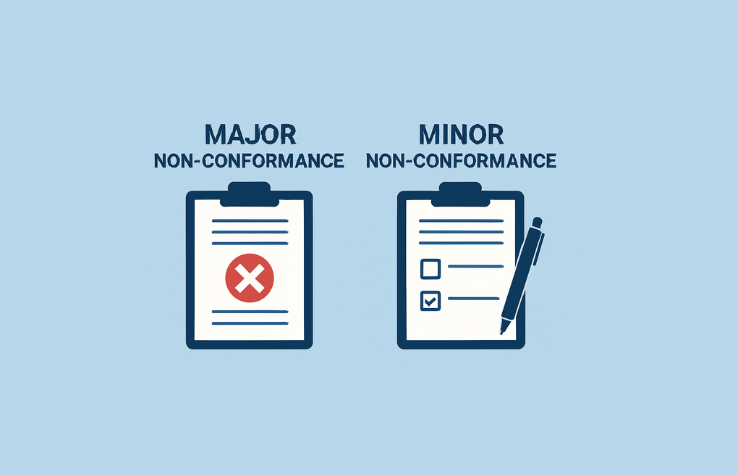
Types of NCR Reports
In ISO management systems, Non Conformance Reports (NCRs) are typically classified into three main types based on risk, severity, and potential impact on compliance, safety, or performance. Understanding these types helps organisations respond correctly and prioritise corrective actions.
Major Non-Conformance
A major non-conformance indicates a serious failure of the management system or a complete breakdown in a critical requirement. It usually shows that the organisation is unable to control a process that directly affects quality, safety, legal compliance, or customer requirements.
Common examples include:
- Absence of a required procedure, such as no documented HACCP plan or missing critical control procedures
- Repeated failure to implement corrective actions from previous audits
- Evidence that a non-conforming product or unsafe process could reach the customer
Major NCRs often require immediate corrective action and may affect certification status if not addressed promptly.
Minor Non-Conformance
A minor non-conformance reflects partial compliance where the system exists but is not consistently or fully implemented. It does not pose an immediate risk, but it still indicates a weakness that could escalate if ignored.
Typical examples include:
- Incomplete or inconsistent records, such as missing signatures or dates
- A procedure being followed in practice but not fully documented
- Isolated lapses in training records or calibration logs
Minor NCRs must still be corrected within an agreed timeframe to prevent recurrence and system deterioration.
Observation or Opportunity for Improvement
An observation or opportunity for improvement (OFI) is not a non-conformance but a professional insight from the auditor. It highlights areas where the organisation can strengthen controls or improve efficiency before a problem occurs.
Examples include:
- A process that meets requirements but relies heavily on manual checks
- Trends that show increasing errors, even though limits are not yet exceeded
- Opportunities to simplify documentation or improve staff awareness
While observations do not require corrective action, organisations that act on them often demonstrate stronger continual improvement and better audit outcomes over time.
Auditors determine the type based on risk, impact, and recurrence.
Key Benefits of Non-Conformance Reports
Non-Conformance Reports play a critical role in strengthening ISO management systems when they are used consistently and correctly. Beyond meeting audit requirements, NCRs help organisations gain better control over their processes, reduce risk, and support continual improvement. The key benefits below explain why NCRs are essential for both compliance and long-term business performance.
Reduces Repeat Problems
Effective management of Non-Conformance Reports helps organisations stop recurring issues at the root. Instead of applying temporary fixes, NCRs require root cause analysis and corrective actions that prevent the same problem from happening again. This saves time, reduces rework, and improves overall process stability.
Strengthens ISO Compliance
A structured NCR system strengthens compliance with ISO standards by ensuring all non-conformities are properly recorded, investigated, and closed. During audits, this demonstrates that the organisation maintains control over its processes and responds effectively to gaps identified by auditors or internal reviews.
Improves Operational Control
NCRs improve operational control by clearly defining responsibilities, actions, and deadlines. Employees understand what went wrong, who is accountable, and how issues are resolved. This clarity reduces confusion and improves consistency across departments and sites.
Supports Smoother Audits
Organisations with effective NCR management experience smoother audits with fewer repeated findings. Auditors see evidence of learning, corrective action effectiveness, and continual improvement, which builds confidence in the management system.
Drives a Culture of Improvement
More importantly, NCRs shift the organisational mindset from reacting to problems to improving systems. ISO standards treat NCRs as a core improvement tool, not a penalty mechanism. When used correctly, NCRs encourage proactive risk management and long-term performance improvement.
What is the Purpose of Using NCRs?
The main purpose of an NCR is to improve system performance. NCRs help organisations identify weaknesses, take corrective action, and prevent the same issue from happening again.
For example, repeated customer complaints about incorrect labelling often reveal training or verification gaps. NCRs force teams to address the root cause instead of applying temporary fixes. This approach supports continual improvement and audit readiness.
When should an NCR be raised?
An NCR should be raised whenever a requirement is not fulfilled. This includes failure to follow procedures, missing records, unmet ISO clauses, regulatory non-compliance, or repeated operational issues.
NCRs commonly arise during internal audits, certification audits, customer complaints, or routine operations. Raising NCRs early through internal audits helps organisations avoid larger findings during external audits.
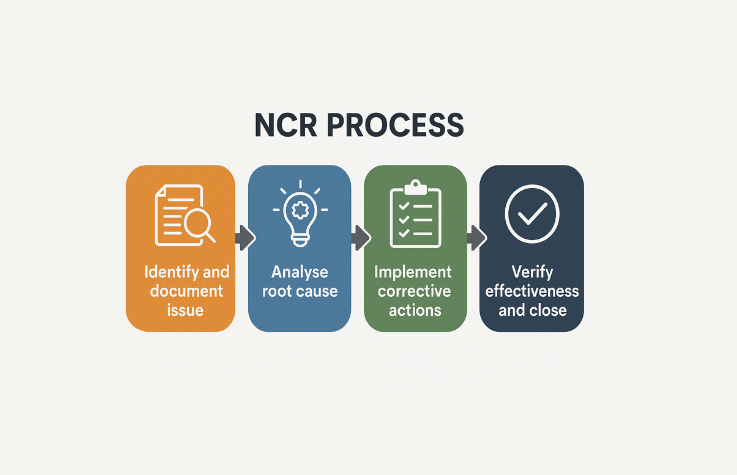
What is the NCR process?
The NCR process follows a structured and logical flow.
- First, the organisation identifies and documents the non-conformance with objective evidence.
- Next, the team performs root cause analysis to understand why the issue occurred.
- Corrective actions are then planned and implemented to eliminate the cause.
- Finally, the organisation verifies the effectiveness of these actions before formally closing the NCR. Auditors focus heavily on root cause quality and effectiveness, not just speed of closure.
Conclusion
An NCR Non Conformance Report is not just an audit requirement. It is a practical tool that helps organisations improve systems, prevent repeat failures, and maintain long-term compliance. When used correctly, NCRs turn audit findings into real operational improvements.
At Connext Consulting, we help organisations move beyond paperwork and build management systems that actually work. Contact us today to strengthen your NCR process or book a consultation to prepare confidently for your next ISO audit.
FAQs
- What is an NCR in ISO 9001?
In ISO 9001, a Non-Conformance Report (NCR) records a failure to meet ISO requirements, customer requirements, or internal procedures. It supports Clause 10 on improvement by ensuring issues are analysed, corrected, and prevented from recurring through effective corrective actions. - When should an NCR be issued?
An NCR should be issued when there is objective evidence that a requirement is not met. This includes missing records, procedures not followed, repeated errors, or ineffective controls. NCRs are commonly raised during internal audits, external audits, customer complaints, or routine operational checks. - What is the NCR process?
The NCR process involves identifying and documenting the non-conformance, analysing the root cause, implementing corrective actions, and verifying their effectiveness. Once actions are confirmed to prevent recurrence, the NCR is formally closed and retained as audit evidence. - Why are NCRs important?
NCRs prevent repeat problems and support continual improvement. They help organisations strengthen system control, reduce operational risk, and demonstrate compliance during audits. Without NCRs, issues often recur and improvements remain temporary rather than sustainable. - How do you prepare an NCR report?
To prepare an NCR report, describe the non-conformance clearly, reference the relevant ISO clause or procedure, and attach objective evidence. Conduct root cause analysis, define corrective actions with responsibilities and deadlines, and verify effectiveness before closing the NCR.